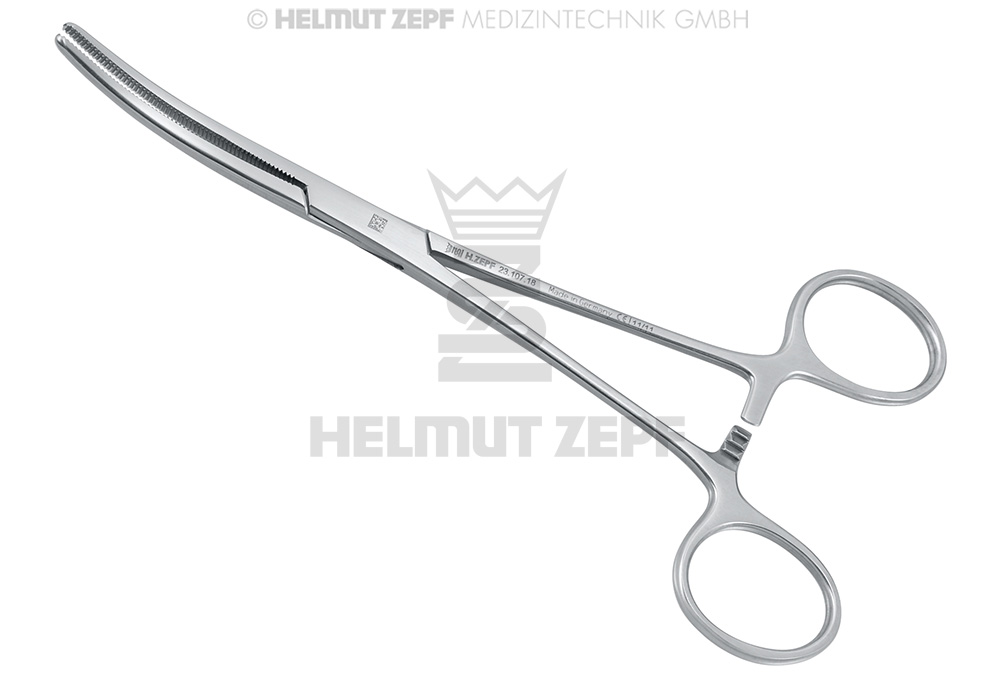
Rochester-Pean Haemostatic Forceps - Helmut Zepf (23.107.18) - Delynov
The Pince hémostatique de Rochester, modèle Péan - Helmut Zepf is a medical device manufactured by Helmut Zepf Medizintechnik GmbH.
- Manufacturer: Helmut Zepf Medizintechnik GmbH.
- Reference: 23.107.18.
- Reserved for healthcare professionals. Read instructions carefully before use.
What is the Rochester-Pean hemostatic forceps?
The Rochester-Pean forceps is a metallic surgical instrument designed by the manufacturer Helmut Zepf Medizintechnik GmbH. Identified under technical reference 23.107.18, this forceps is characterized by a robust structure and serrated jaws allowing for stable gripping. In oral surgery, it is primarily used as surgical hemostatic forceps to control bleeding by clamping vessels or to manipulate dense tissues. Its design by Helmut Zepf guarantees precise adjustment of the jaws, essential for technical maneuvers in confined environments. This instrument is an integral part of the arsenal for guided bone regeneration (GBR) and oral surgery procedures requiring constant holding force without slipping.
What are the clinical indications for this Helmut Zepf instrument?
The use of the Rochester-Pean forceps is indicated in various oral and implant surgery procedures. It is mainly used for immediate hemostasis by compression of severed vessels before their ligation or electrocoagulation. Beyond this primary function, it is employed for grasping and exposing tissue flaps, removing debris or foreign bodies, as well as for holding membranes during GBR protocols. Its versatility makes it a tool of choice for practitioners performing complex extractions or bone reconstruction surgeries. The Rochester model, more robust than Halsted-type forceps, is particularly suitable for thicker tissues encountered in the palatal area or when manipulating dense connective tissues.
What are the technical characteristics of reference 23.107.18?
Reference 23.107.18 corresponds to a specific model of Rochester-Pean forceps produced by Helmut Zepf. Technical characteristics include a multi-position ratchet locking system, allowing for modulation of the pressure exerted by the jaws on tissues or vessels. The working part features deep transverse serrations along the entire length of the jaws, ensuring maximum friction and preventing the slippage of clamped structures. The length and curvature of the instrument are optimized to offer ergonomic access to the posterior sectors of the oral cavity. The surface finish is designed to limit reflections under surgical lighting, thus facilitating the precision work of the dental surgeon during critical phases of the procedure.
What are the contraindications for the use of this hemostatic forceps?
There are no specific absolute medical contraindications for the use of the Rochester-Pean forceps, other than those related to the surgical protocols themselves. However, its use should be avoided on fragile structures or nerve tissues that could be damaged by the compression force and the jaw serrations. The instrument must not be used if it shows signs of corrosion, deformation, or if the ratchet mechanism does not engage correctly, as this could compromise patient safety. Practitioners must ensure that the patient does not have hypersensitivity to the metallic components of the instrument. Finally, misuse for manipulating extremely hard materials (such as drills or abutments) could irreversibly damage the jaws.
What are the maintenance precautions for this non-resorbable device?
As a reusable metallic instrument, the Rochester-Pean forceps requires a strict decontamination and sterilization protocol after each use. It is recommended to follow the instructions from the manufacturer Helmut Zepf Medizintechnik GmbH regarding manual or ultrasonic cleaning, drying, and autoclaving. Particular attention must be paid to the hinge and the jaw serrations to eliminate all organic residue. The application of a specific lubricant for surgical instruments on the joint is advised to maintain fluidity of movement and prevent premature wear. Before each procedure, the practitioner must check the perfect alignment of the jaws and the integrity of the ratchet to guarantee effective and secure hemostasis.
Who is the manufacturer and what standards are respected?
The official manufacturer of this device is Helmut Zepf Medizintechnik GmbH, a recognized company in the dental and surgical instrumentation sector. Although detailed regulatory specifications such as the exact class or CE marking are not explicitly mentioned in the technical data provided for this reference 23.107.18, Helmut Zepf is renowned for producing devices that comply with the high quality standards of the German medical industry. For any precise information concerning the regulatory class (generally Class I or Class IIa for this type of manual instrumentation) or the CE certificate of conformity, it is imperative to refer to the instructions for use or technical documentation provided by the manufacturer accompanying the product.
State of the art
Guided bone regeneration (GBR) in implantology relies on membrane fixation quality.
Specifications
| Manufacturer | Helmut Zepf |
| Tags | |
|---|---|
| Tags | |