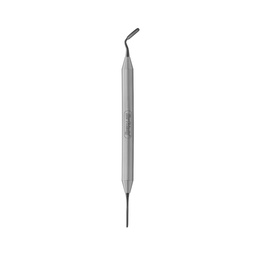
Wilkins/Tufts Probe #TU17 handle #30 - Hu-Friedy - Delynov
The Sonde Wilkins/Tufts #TU17 manche #30 - Hu-Friedy is a medical device manufactured by Hu-Friedy Mfg. Co., LLC.
- Compliance: Medical device Class I.
- Manufacturer: Hu-Friedy Mfg. Co., LLC.
- Reserved for healthcare professionals. Read instructions carefully before use.
| Manufacturer: Hu-Friedy |
Complete your order
Our customers often order these together

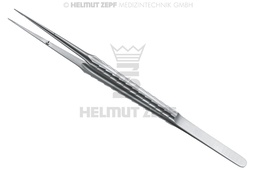
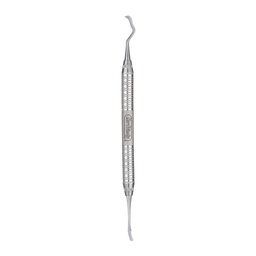
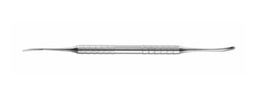
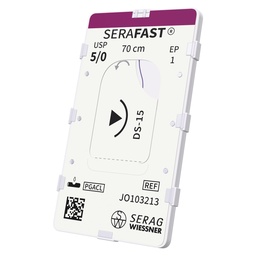 SERAFAST Absorbable Violet Suture 5/0 DS-15 Needle 70cm - Serag & Wiessner - JO103213
Recommended suture
What is the Wilkins/Tufts #TU17 probe with #30 handle?
La sonde Wilkins/Tufts #TU17, associée au manche #30, est un instrument d'examen manuel conçu pour l'exploration fine des tissus parodontaux. Sa structure combine une extrémité de travail calibrée et un manche ergonomique de grand diamètre (série #30) destiné à améliorer la préhension lors des examens cliniques prolongés. En tant que sonde d'exploration, elle permet au praticien d'évaluer l'état de la surface radiculaire et l'intégrité de l'attache épithéliale avec une haute sensibilité tactile.
What are the clinical indications for this instrument?
The tufts periodontal probe is indicated for the diagnosis and monitoring of periodontal pathologies. It is primarily used to measure probing depth, evaluate clinical attachment levels, and detect the presence of subgingival calculus or prosthetic overhangs. In oral surgery and periodontology, this instrument is essential for establishing an accurate odontogram and for monitoring the evolution of periodontal pockets after root planing treatment or surgical intervention. Its use allows for the indirect quantification of bone loss by measuring recession and the depth of gingival sulci.
What are the technical characteristics of the Wilkins/Tufts probe?
This Wilkins/Tufts probe is distinguished by the specific configuration of its #TU17 tip, adapted to the anatomy of difficult-to-access areas. The Hu-Friedy #30 handle offers an optimized diameter to reduce clinician muscle fatigue while effectively transmitting vibrations during the detection of calcified deposits. Manufacturing is based on the quality standards of Hu-Friedy Mfg. Co., LLC, ensuring corrosion resistance and durability compatible with repeated autoclave sterilization cycles. The instrument is designed to offer an optimal balance between flexibility and rigidity, necessary for reliable periodontal exploration.
What are the contraindications for the use of this probe?
There are no specific absolute medical contraindications for the use of the Wilkins/Tufts #TU17 probe reported in the manufacturer's technical documentation, outside of standard hygiene protocols. However, the use of this instrument should be avoided on gingival tissues presenting severe acute inflammation without prior precautions, to avoid causing unnecessary trauma. It is the responsibility of the healthcare professional to judge the relevance of the examination based on the patient's clinical state and to ensure the absence of known hypersensitivity to the metals constituting the instrument.
What are the maintenance and storage precautions?
As a non-absorbable and reusable instrument, the Hu-Friedy Wilkins/Tufts probe requires a rigorous decontamination and sterilization protocol after each use. It is imperative to read the instructions carefully before use to comply with the cleaning parameters recommended by the manufacturer. Precautions include the use of neutral pH cleaning solutions and regular visual inspection of the working end to detect any deformation or wear of the markings, which could distort clinical measurements. Storage in a dry and protected environment is recommended to maintain device integrity.
Who is the manufacturer and what standards are met?
La sonde Wilkins/Tufts #TU17 est un dispositif médical de Classe I. Ce produit répond aux exigences de fabrication des dispositifs médicaux de Classe I destinés aux professionnels de santé. Hu-Friedy est mondialement reconnu pour sa conformité aux normes de qualité strictes dans la production d'instruments manuels. Ce produit est exclusivement réservé à un usage professionnel en cabinet de chirurgie orale ou en milieu hospitalier.
State of the art
Specialized surgical instrumentation is evolving towards ergonomic designs.