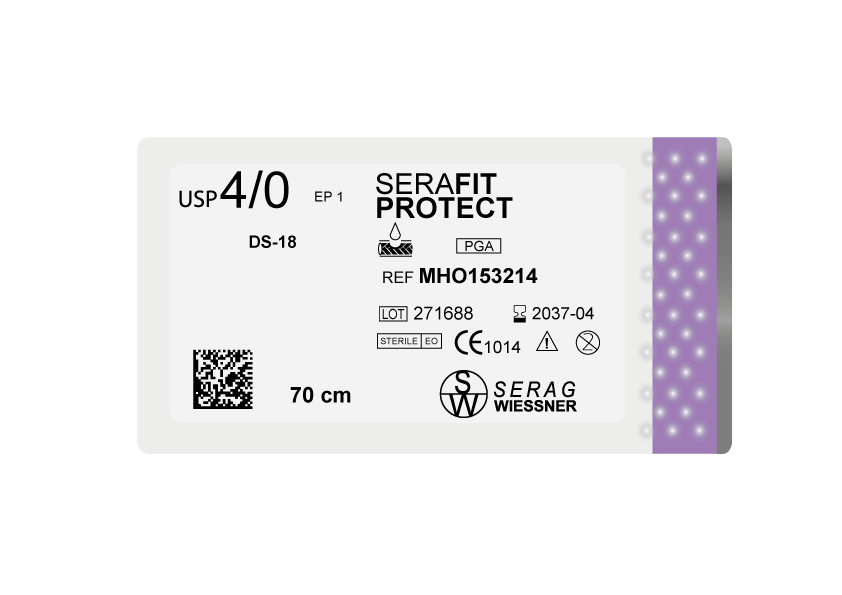
X24 SERAFIT PROTECT violet (4/0) 1x0.70 DS-18 - Serag & Wiessner
The SERAFIT suture by Serag-Wiessner GmbH & Co. KG is a monofilament synthetic medical device designed for progressive absorption in oral, periodontal, and implant surgery.
- Absorption: Rapid, progressive absorption by hydrolysis.
- Needle: DS-18 (18 mm), 3/8 circle, triangular reverse cutting tip.
- Format: Thread length 70 cm, caliber 4/0 (USP).
- Packaging: Box of 24 single-use sterile sutures.
- Manufacturer: Serag-Wiessner GmbH & Co. KG.
What is the SERAFIT PROTECT absorbable violet (4/0) suture?
SERAFIT PROTECT from the brand Serag-Wiessner is an absorbable surgical suture device of violet color. Presented in calibre 4/0, this thread is designed to meet the requirements of surgical interventions necessitating temporary wound closure with programmed absorption. Packaged in boxes of 24 units under reference MHO153214, each thread measures 70cm. Its structure and violet color ensure excellent visibility during handling in wet environments or during exposure of the operative field, thus facilitating precision work for the practitioner.
What are the clinical indications for this Serag-Wiessner device?
Although specific MDR indications are not detailed here, SERAFIT PROTECT type sutures of calibre 4/0 are commonly used in oral surgery, periodontal surgery, and implantology. Their use is particularly suitable for the approximation of soft tissues and mucous membranes where absorption is desired to avoid a stitch removal step. The thread length of 70cm allows for great freedom of movement during complex sutures or extensive flap closures, guaranteeing effective management of hemostasis and gingival healing.
What are the technical characteristics of the DS-18 needle?
The DS-18 needle associated with this Serag-Wiessner suture presents specific technical properties for surgery. The 'DS' code indicates a 3/8 circle needle equipped with a reverse cutting triangular point. This configuration is ideal for passing through dense tissues without causing undesirable tissue tearing, as the cutting edge is located on the outside of the curvature. The number '18' specifies that the needle has a length of 18 mm, offering an optimal compromise between maneuverability and penetration for tissues of the oral cavity.
What are the contraindications for the use of this suture?
The use of the SERAFIT PROTECT absorbable suture must be avoided in situations where permanent or prolonged mechanical tissue support is required, due to its absorbable nature. It is imperative not to use this device in patients with known sensitivities to synthetic absorbable suture materials. For any specific application or clinical doubt, healthcare professionals must imperatively refer to the instructions for use provided by the manufacturer Serag-Wiessner GmbH & Co. KG to ensure patient safety.
How does absorption occur and what are the precautions?
As an absorbable suture, SERAFIT PROTECT progressively loses its tensile strength as it degrades within the body. Although precise data on the hydrolysis mechanism are not provided in this technical sheet, this type of material is designed to be eliminated naturally. The practitioner must ensure secure knots are tied and adapt the suture tension so as not to compromise tissue vascularization during the healing phase. Standard post-operative monitoring is recommended to check the progress of the sutured area.
Who is the manufacturer and what is the regulatory information?
The official manufacturer of this device is Serag-Wiessner GmbH & Co. KG, a company recognized for its expertise in the design of surgical sutures. The product is identified under the commercial name SERAFIT PROTECT with the reference code MHO153214. Regarding the regulatory class, CE marking, or specific ISO standards, this information is not specified in the current technical documentation. Surgeons and implantologists are invited to consult the product labeling and the instruction manual to verify compliance with current regulatory requirements before any use.
State of the art
Modern synthetic sutures - absorbable or non-absorbable - are central to wound healing in oral surgery. Recent advances focus on reducing post-operative infections.