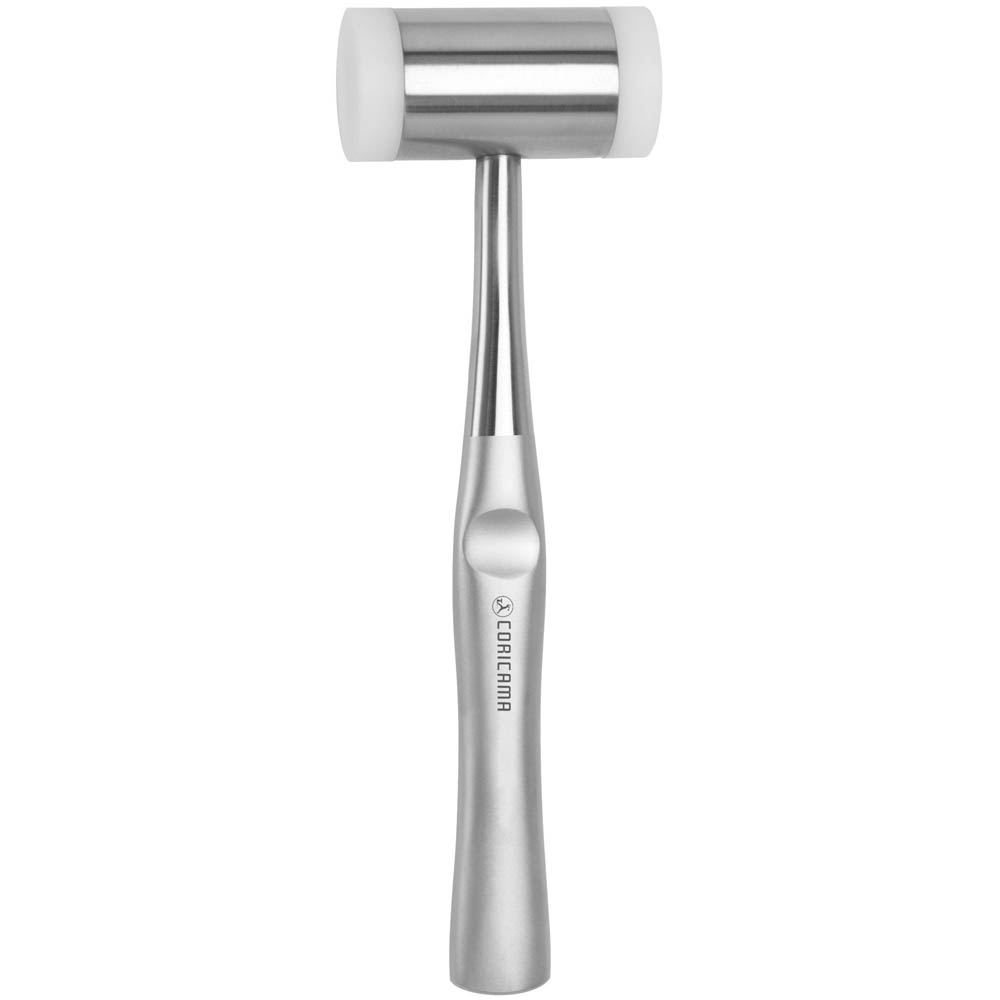
Title Mead Maillet 320g MM180 (462270) by Coricama - Delynov
The Maillet Mead 320g MM180Coricama is a medical device manufactured by CORICAMA srl.
- Manufacturer: CORICAMA srl.
- Reference: 462270.
- Reserved for healthcare professionals. Read instructions carefully before use.
What is the Coricama Mead mallet 320g MM180 (462270)?
The Mead mallet 320g MM180, referenced under code 462270, is a manual percussion instrument designed by CORICAMA for oral surgery interventions. This tool consists of a central body and two striking faces, offering a total mass of 320g. This specific configuration allows for optimal inertia when using third-party instruments such as osteotomes or chisels. Its structure is designed to ensure efficient energy transmission while limiting excessive rebound, thus facilitating the practitioner's work during bone remodeling or manual drilling stages.
What are the clinical indications for this dental mead mallet?
The dental mead mallet is primarily indicated in bone surgery and implantology protocols. In oral surgery, it accompanies the use of bone chisels for resections or alveolar ridge regularizations. In implantology, the mead mallet is essential during ridge expansion (split control) or for performing crestal sinus lifts using osteotomes. It allows for precise impaction of instruments to condense bone or create an implant housing without thermal heating, unlike rotary instruments. Its use also extends to the removal of prostheses or fixed elements when impact force is required.
What are the technical characteristics of the MM180 model?
The MM180 model from the CORICAMA brand stands out for its calibrated weight of 320g, offering an ideal compromise between maneuverability and impact power. Its technical reference 462270 guarantees precise traceability of the device. The Mead mallet design is based on a balanced mass distribution, allowing for a stable grip for the surgeon. The striking surfaces are sized to minimize the risk of slipping during contact with the percussed instrument. Although specific materials are not listed in the source data, this type of instrument is traditionally designed to withstand repeated sterilization cycles in a clinical environment.
What are the contraindications for the use of this device?
Contraindications to the use of the Mead mallet 320g MM180 are related to clinical situations where mechanical impact force is prohibited. This includes areas with extreme bone fragility or sensitive anatomical structures in the immediate vicinity (inferior alveolar nerve, maxillary sinuses without adequate protection). The use of this instrument is discouraged if the patient presents with serious systemic bone pathologies making the bone abnormally brittle. It is the surgeon's responsibility to evaluate bone density and the relevance of percussion compared to other less invasive techniques according to the clinical case presented.
What are the maintenance and handling precautions?
Like any non-resorbable manual surgical instrument, the Mead mallet 320g MM180 requires rigorous maintenance. After each intervention, it must be cleaned and decontaminated according to current protocols to eliminate organic residues. It is imperative to check the integrity of the striking surfaces before each use to ensure that no deformation can alter the precision of the impact. Storage must be in a dry environment. Although robust, the instrument must be handled with care to preserve its mass balance and avoid any fall that could damage the threads or striking faces.
Who is the manufacturer and what standards are respected?
The official manufacturer of this device is CORICAMA srl, a company recognized in the manufacture of high-precision surgical instrumentation. As a product marketed by CORICAMA, this Mead mallet meets the brand's manufacturing requirements. Regarding specific certifications such as CE marking or MDR regulatory class, this information is not specified in the current technical documentation. It is therefore recommended that users systematically refer to the instructions for use provided by the manufacturer and the labeling on the original packaging to confirm regulatory compliance before any use in the operating room.
State of the art
Surgical medical consumables play a decisive role in operative safety.