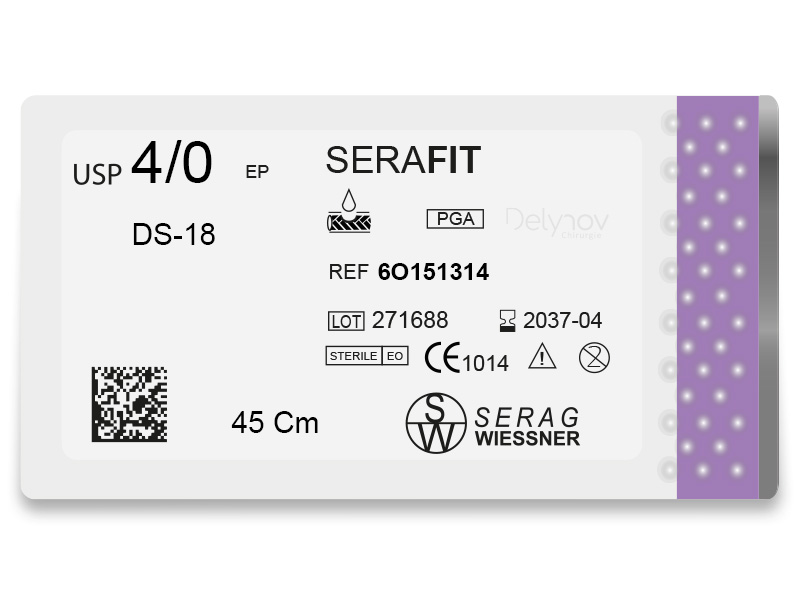
SERAFIT absorbable violet (4/0) DS-18 needle of 45 CM box of 24 sutures - Serag & Wiessner (6O151314) - Delynov
The SERAFIT suture by Serag-Wiessner GmbH & Co. KG is a monofilament synthetic medical device designed for progressive absorption in oral, periodontal, and implant surgery.
- Absorption: Rapid, progressive absorption by hydrolysis.
- Needle: DS-18 (18 mm), 3/8 circle, triangular reverse cutting tip.
- Format: Thread length 45 cm, caliber 4/0 (USP).
- Packaging: Box of 24 single-use sterile sutures.
- Compliance: Medical device Class III, CE marking CE1014.
- Manufacturer: Serag-Wiessner GmbH & Co. KG.
What is SERAFIT absorbable violet (4/0)?
SERAFIT from the brand Serag-Wiessner is a synthetic and absorbable surgical suture thread of 4/0 calibre. This Class III medical device comes in a braided multifilament form, composed of a homopolymer of glycolic acid. Its violet color ensures excellent visibility during surgery. Packaged in boxes of 24 sutures, each thread measures 45cm and can be coated with calcium stearate with polycaprolactone or polyglycolic acid to optimize tissue passage. This material is considered an Optime equivalent in current clinical practices for soft tissue management.
What are the clinical indications for this suture?
Although the general intended use is surgical suturing, this material is particularly suitable for oral, implant, and periodontal surgery interventions. As an absorbable suture, SERAFIT is indicated for the closure of hollow organs or the coaptation of tissues not requiring permanent mechanical support. The manufacturer Serag-Wiessner specifies that ligatures constitute a particular type of application for this thread. The choice of this device must take into account the in-vivo characteristics of the material and the specific surgical techniques mastered by the practitioner.
What are the technical characteristics of the DS-18 needle?
The DS-18 needle mounted on this 45cm suture has specific properties for fine surgery. The 'DS' code designates a 3/8 circle needle with a triangular reverse cutting point. This configuration is ideal for passing through dense tissues without causing traumatic tearing. The number '18' indicates a needle body length of 18 mm. This combination of a 4/0 calibre and a DS18 needle allows for increased precision when handling in restricted spaces, guaranteeing fluid penetration and optimal control of the needle path.
What are the contraindications for the use of SERAFIT?
The use of SERAFIT is strictly contraindicated in clinical situations where prolonged or long-term mechanical stability of the suture material is essential. Furthermore, this device must never be used in patients with a known allergy to any of its components, notably glycolic acid, calcium stearate, or polycaprolactone. The manufacturer Serag-Wiessner GmbH & Co. KG also emphasizes that the use of absorbable sutures may prove inadequate in certain specific pathological conditions, requiring a rigorous benefit/risk assessment by the surgeon before implantation.
How does absorption occur and what are the precautions?
The absorption of SERAFIT occurs by hydrolysis in the tissues, transforming the polymer into glycolic acid which is then metabolized by the body. This process first results in a loss of tension: the breaking strength decreases by approximately 60% after 14 days (in vitro data). Total absorption of the thread mass is generally completed after approximately 90 days in-vivo. Particular caution is required in patients with delayed healing or in poorly irrigated tissues, as suture extrusion or delayed absorption may occur.
Who is the manufacturer and what standards are respected?
These sutures are manufactured by Serag-Wiessner GmbH & Co. KG, a recognized manufacturer based in Germany. The product complies with the strictest regulatory requirements as a Class III medical device, bearing the CE1014 marking. Each box contains 24 sterile units, identified under technical reference 6O151314. Compliance with these standards guarantees the traceability and safety of the material for invasive surgical procedures. It is imperative for the user to carefully read the instructions and be familiar with the required surgical techniques before any use.
State of the art
Modern synthetic sutures - absorbable or non-absorbable - are central to wound healing in oral surgery. Recent advances focus on reducing post-operative infections.
Specifications
| Manufacturer | Serag-Wiessner Suture Materials |
| Tags | |
|---|---|
| Tags | |