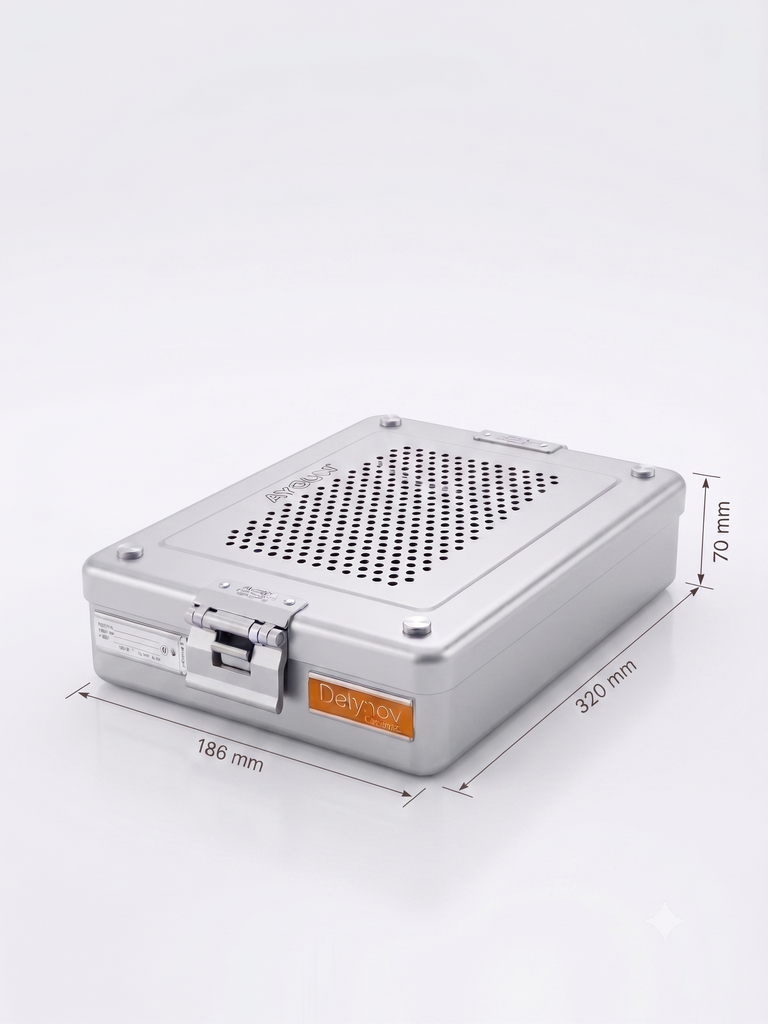
Container de stérilisation 320x186x70mm avec filtres Téflon - Couvercle Brun - Delynov (Aygün) (copie)
The Container de stérilisation 320x186x70mm avec filtres Téflon - Couvercle Gris is a medical device.
- Manufacturer: .
- Reserved for healthcare professionals. Read instructions carefully before use.
What is the 320x186x70mm sterilization container with Teflon filters?
This sterilization container is an instrumentation management device specifically sized to meet the needs of oral surgery practices. With dimensions of 320x186x70mm, it offers a volume adapted to the storage and sterilization of complete instrument sets. Its structure is completed by a distinctive grey lid and an advanced filtration system. Unlike systems using disposable paper filters, this model integrates Teflon filters, recognized for their durability and efficiency during steam sterilization cycles. It is a robust solution for securing the aseptic chain, protecting tools against external contamination after thermal treatment.
What are the clinical indications for this sterilization box?
The use of this dental sterilization container is indicated for all practitioners performing implant surgery, periodontology, or oral surgery procedures requiring sterile instrumentation. It serves as a sterile barrier between the autoclave and the operating field. In a clinical setting, it allows instruments to be grouped by type of intervention (extraction, implant placement, bone grafting) while ensuring that steam penetrates uniformly thanks to its integrated filters. Its intermediate format of 320x186x70mm is ideal for standard technical trays, allowing for optimized storage in Class B autoclaves commonly used in dental practices.
What are the technical characteristics of the 320x186x70mm container?
The main technical characteristics of this product lie in its precise dimensions of 320x186x70mm and its filtration system. The height of 70mm allows it to accommodate instruments of different sizes while remaining compact. The grey-colored lid allows for quick differentiation of surgical kits, improving the efficiency of healthcare personnel during room preparation. The major technical element is the integration of Teflon filters. These filters are designed to withstand repeated sterilization cycles without losing their microbial barrier properties. The closing mechanism ensures a reliable seal, essential for maintaining sterility during post-autoclave storage.
What are the contraindications for the use of this device?
There are no direct clinical contraindications related to the use of this container, as it does not come into direct contact with the patient. However, its use is contraindicated with sterilization methods incompatible with Teflon or the constituent materials of the box, such as dry heat sterilization (poupinel) if the manufacturer's specifications do not explicitly allow it. It must not be used if the seals or filters show visible signs of degradation, tearing, or deformation, as this would compromise the sterile barrier. It is imperative to respect the preliminary cleaning protocols to avoid any accumulation of organic residues.
What are the maintenance precautions for Teflon filters?
The Teflon filters integrated into this sterilization container offer the advantage of increased longevity compared to conventional filters. However, precautions must be taken to guarantee their long-term effectiveness. During cleaning, the use of sharp objects or metal brushes that could damage the filter structure should be avoided. It is recommended to visually check the integrity of the filters and the fastening system before each sterilization cycle. Although non-absorbable and designed for repeated use, these components must be handled with care to avoid any perforation. Compliance with the autoclave cycle parameters (temperature and pressure) recommended for this type of equipment is essential to preserve the physical properties of the Teflon.
Who is the manufacturer and what standards are respected?
This container is manufactured by a recognized entity in the field of surgical sterilization technology. Although specific certifications (such as CE marking or regulatory class) are not detailed in the current source data, this type of device is generally designed to meet the strict requirements of international standards relating to sterile barrier systems. For any precise information concerning regulatory compliance, ISO certifications, or specific maintenance instructions, it is imperative to refer to the instructions for use provided by the manufacturer and the labels present on the product. The practitioner must ensure that the device is used in accordance with current recommendations for the sterilization of medical devices.
State of the art
Surgical medical consumables play a decisive role in operative safety.