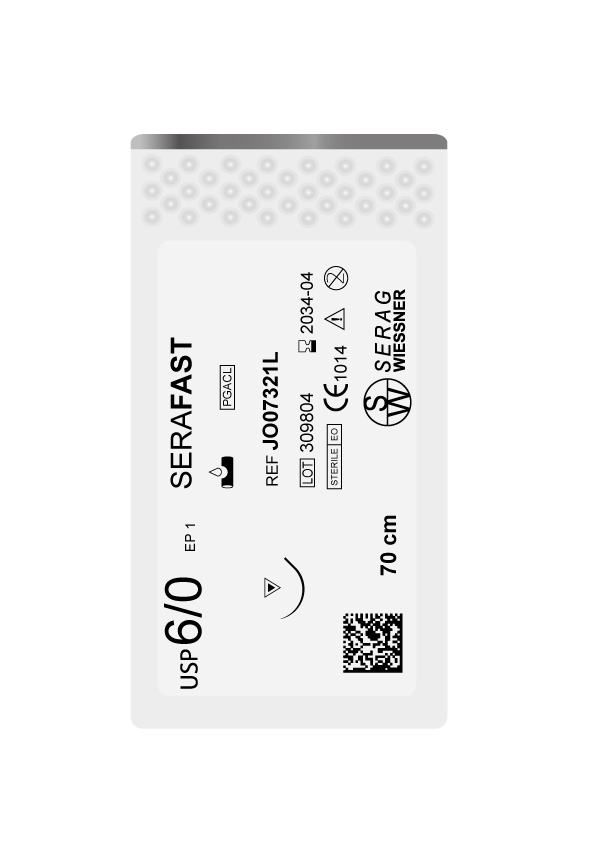
SERAFAST absorbable violet (6/0) DSS-13 needle of 70 CM box of 24 sutures - Serag & Wiessner (JO07321L) - Delynov
Product features
The SERAFAST suture by Serag-Wiessner GmbH & Co. KG is a monofilament synthetic medical device designed for rapid absorption in oral, periodontal, and implant surgery.
- Material: Polyglycolide-Caprolactone (PGACL).
- Absorption: Rapid, 10 to 15 days.
- Needle: DSS-13 (13 mm), 3/8 circle, atraumatic triangular tip.
- Format: Thread length 70 cm, caliber 6/0 (usp).
- Packaging: Box of 24 single-use sterile sutures.
- Compliance: Class III medical device, CE marking CE1014.
- Manufacturer: Serag-Wiessner GmbH & Co. KG.
fabricant : serag-wiessner gmbh & co. kg, zum kugelfang 8-12, 95119 naila/germany usage prévu : suture surgical : description et emploi prévuserafast® est un matériau de suture chirurgicale monofilament, synthétique et résorbable. il est composé d'un copolymère segmenté avec les composants de base glycolide et e-caprolactone. il est fourni teinté avec un colorant violet d+c no 2 (colour index n° 60725) ou non teinté. serafast® est disponible en différents calibres et longueurs. il est fourni avec différents types d'aiguilles en acier chirurgical. serafast® peut être associé à d'autres composants, comme un tube de guidage de suture. le matériel de suture est conforme à la monographie de la pharmacopée européenne (pe) «suture stérile synthétique résorbable monofilament (fila resorbilia synthetica monofilamenta sterilia)». serafast® est prévu pour l’adaptation des tissus mous ou pour les ligatures quand il est indiqué d’utiliser du matériel de suture résorbable rapidement (jusqu’à 2 semaines). lire attentivement la notice. avertissements et précautions : contre-indications serafast® ne doit pas être utilisé lorsqu’une stabilité prolongée ou durable du matériel de suture est nécessaire, comme p. ex. lors de fixation d’implants synthétiques (valves cardiaques, etc.). serafast® n’est pas destiné à être utilisé dans le système cardio-vasculaire central ou le système nerveux central. le dispositif ne doit pas être utilisé chez les patients présentant des allergies à l'un des composants du produit. restrictions et limites d'utilisation / remarques / interactions les exigences en termes de matériel de suture et de techniques nécessaires varient suivant les indications. le choix du matériel de suture doit tenir compte des caractéristiques du matériel de suture concerné. serafast® doit être utilisé avec prudence chez les patients présentant un retard de cicatrisation. comme tout corps étranger, le dispositif peut provoquer la formation de calculs quand il reste en contact prolongé avec des solutions contenant du sel (p. ex. dans les voies biliaires ou urinaires). pour les sutures sous tension ou nécessitant une plus grande résistance, il peut être nécessaire d’utiliser en plus un matériau de suture non résorbable ou d’appliquer des techniques d'immobilisation appropriées. dans le cas des sutures intracutanées, le matériel de suture, en particulier les nœuds, doit être placé le plus profondément possible. les instruments chirurgicaux doivent être manipulés avec précaution pour éviter d’endommager les fils. il ne faut pas plier les aiguilles ou les saisir en dehors de la zone recommandée pour éviter qu’elles se brisent. étant donné le risque d’infection inhérent aux piqûres d’aiguilles, celles-ci doivent être manipulées avec un soin particulier. il convient d'être prudent dans l'utilisation de sutures résorbables dans des tissus présentant une faible irrigation sanguine, car une extrusion de la suture et une résorption retardée sont possibles. l'utilisation des sutures résorbables peut s'avérer inappropriée chez les personnes âgées, dénutries ou affaiblies. les sutures cutanées qui restent en place plus de 7 jours peuvent provoquer une irritation locale et doivent être coupées ou retirées. réservé aux professionnels de santé.
What is the violet absorbable SERAFAST (6/0) from Serag-Wiessner?
Violet SERAFAST is a monofilament, synthetic, and absorbable surgical suture material designed by Serag-Wiessner. Its monofilament structure limits bacterial adhesion and facilitates passage through tissue. It is composed of a segmented copolymer combining glycolide and e-caprolactone. This suture is dyed with a violet D+C No 2 dye (Colour Index n° 60725) to provide excellent visibility during surgery. Packaged in boxes of 24 units, this device features a 6/0 (USP) calibre and a thread length of 70 cm, meeting the precision requirements of surgeons during soft tissue adaptation. The material complies with the European Pharmacopoeia monograph for sterile synthetic absorbable monofilament sutures.
What are the clinical indications for SERAFAST?
SERAFAST from Serag-Wiessner is specifically indicated for soft tissue adaptation or for performing ligations. Its use is recommended when it is necessary to use an absorbable suture material rapidly, with targeted efficacy over a period of up to 2 weeks. In oral and implant surgery, it is perfectly suited for the closure of surgical sites requiring rapid healing and delicate handling. The choice of this material must imperatively take into account the specific characteristics of the product and the technical requirements of the surgical act. It is particularly recommended for interventions where the maintenance of suture tension is not required over the long term.
What are the technical characteristics of the DSS-13 needle?
The SERAFAST JO07321L suture is equipped with a technical needle referenced DSS-13. According to the nomenclature, the DSS needle corresponds to a 3/8 circle needle equipped with an atraumatic reverse cutting triangular point. This configuration is specifically designed for the penetration of delicate tissues and thin mucous membranes, minimizing tissue trauma during thread passage. The number 13 indicates a needle length of 13 mm. Manufactured from high-quality surgical steel, this needle allows for precise and secure handling, essential for 6/0 calibre sutures used in narrow or sensitive anatomical areas encountered in dental and oral surgery.
What are the contraindications for the use of this suture?
SERAFAST has strict contraindications defined by the manufacturer Serag-Wiessner GmbH & Co. KG. It must not be used when prolonged or lasting stability of the suture material is required, such as in the fixation of synthetic implants like heart valves. This device is not intended for use in the central cardiovascular system or the central nervous system. Furthermore, use is prohibited in patients with known allergies to any of its components, notably glycolide, e-caprolactone, or the violet dye. Particular caution is recommended in patients with delayed healing, as the material resorbs rapidly.
How does resorption occur and what are the precautions for use?
SERAFAST is an absorbable device whose loss of strength occurs rapidly, being indicated for maintenance needs of up to 2 weeks. Like any foreign body, it must be used with caution. Suture techniques and material requirements vary according to clinical indications; the practitioner must therefore adapt their choice to the specific needs of the wound. The instructions for use should be read carefully before use. For patients with risk factors for slow healing, use must be evaluated carefully. The product is supplied sterile and must be handled according to standard aseptic protocols to ensure patient safety and the integrity of the synthetic monofilament.
Who is the manufacturer and what standards are met?
This suture is manufactured by Serag-Wiessner GmbH & Co. KG, headquartered in Naila, Germany. The product is classified as a Class III medical device, meeting the strictest regulatory requirements for surgical implants. It bears the CE1014 marking, guaranteeing its compliance with European safety and performance standards. The suture material strictly complies with the European Pharmacopoeia (EP) monograph entitled 'sterile synthetic absorbable monofilament suture' (fila resorbilia synthetica monofilamenta sterilia). These certifications provide dental surgeons and implantologists with a high-quality, traceable product adapted to complex surgical interventions.
State of the art
Modern synthetic sutures — absorbable or non-absorbable — are central to wound healing in oral surgery. Recent advances focus on reducing post-operative infections, optimizing keratinized gingival tissue thickness, and innovating composite materials.
Further reading on Delynov
- The Scientific Breakthrough Redefining Surgical Sutures: A Bulwark Against Infection
In the world of surgery, every detail is critical to ensuring procedural success and patient healing. Among the most closely monitored risks is that of surgical site infection… - Soft Tissue Management: Apical Mattress Suture Increases Keratinized Gingiva Thickness
Introduction The quality and quantity of peri-implant soft tissues are determining factors for long-term treatment success, influencing hygiene maintenance, the... - Innovation in Resorbable Sutures: A Cellulose and Propolis-Based Composite for Oral Surgery
Introduction: Suture material, the earliest known type of implant in history, remains a fundamental component of surgery. An ideal material must combine several demanding properties: high tensile strength, biocompatibility, and optimal handling characteristics.
Specifications
| Manufacturer | Serag-Wiessner Suture Materials |
| Tags | |
|---|---|
| Tags | |