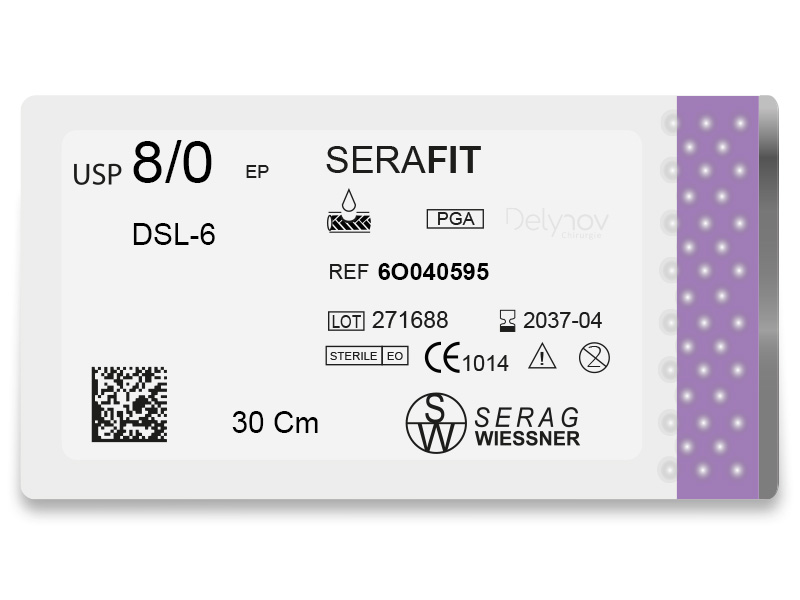
SERAFIT absorbable violet (8/0) needle DSL-6 of 30 CM box of 24 sutures - Serag & Wiessner (6O040595) - Delynov
The SERAFIT suture by Serag-Wiessner GmbH & Co. KG is a monofilament synthetic medical device designed for progressive absorption in oral, periodontal, and implant surgery.
- Material: de suture multifilament tressé, synthétique, résorbable. il est composé de l'homopolymère de l'acide glycolique. serafit® peut être recouvert de stéarate de calcium avec polycaprolactone ou d'acide polyglycolique/polyligatures sont un type particulier de suture dont l'objectif est de fermer des organes creux.
- Absorption: Rapid, progressive absorption by hydrolysis.
- Needle: DSL-6.
- Format: Thread length 30 cm, caliber 8/0 (USP).
- Packaging: Box of 24 single-use sterile sutures.
- Compliance: Medical device Class III, CE marking CE1014.
- Manufacturer: Serag-Wiessner GmbH & Co. KG.
| Manufacturer: Serag-Wiessner Suture Materials |
Complete your order
Based on our customers' orders
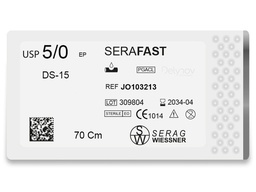 SERAFAST Absorbable Violet Suture 5/0 DS-15 Needle 70cm - Serag & Wiessner - JO103213
Recommended suture
SERAFAST Absorbable Violet Suture 5/0 DS-15 Needle 70cm - Serag & Wiessner - JO103213
Recommended suture
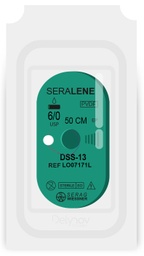 SERALENE non-absorbable blue (6/0) DSS-13 needle of 50 CM box of 24 sutures - Serag & Wiessner (LO07171L) - Delynov
Recommended suture
SERALENE non-absorbable blue (6/0) DSS-13 needle of 50 CM box of 24 sutures - Serag & Wiessner (LO07171L) - Delynov
Recommended suture
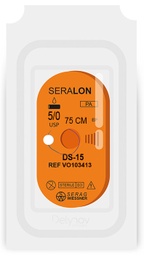 SERALON non absorbable blue (5/0) DS-15 needle 75 CM box of 24 sutures - Serag & Wiessner (VO103413) - Delynov
Recommended suture
SERALON non absorbable blue (5/0) DS-15 needle 75 CM box of 24 sutures - Serag & Wiessner (VO103413) - Delynov
Recommended suture
 Master-Pin refill (pin) - (MP10) - Meisinger - Hager & Meisinger GmbH (36BMP000010) - Delynov
What is violet absorbable SERAFIT (8/0)?
Violet absorbable SERAFIT is a surgical suture medical device developed by Serag-Wiessner. It comes in the form of a braided and synthetic multifilament material, designed to offer excellent handling. Its composition is based on polyglycolic acid homopolymer, which provides its absorption properties. To improve glide through tissue, this ophthalmic suture can be coated with calcium stearate associated with polycaprolactone or polyglycolic acid. Its violet color ensures optimal visibility in the operative field, while its ultra-fine 8/0 calibre makes it suitable for high-precision work where material discretion is paramount.
What are the clinical indications for this Serag-Wiessner suture?
This suture is primarily indicated for soft tissue approximation and performing ligatures. As an ophthalmic suture, it is used in surgical procedures where absorption is desired. The manufacturer Serag-Wiessner GmbH & Co. KG specifies that ligatures constitute a particular type of suture whose specific objective is to close hollow organs. Its use is common in microsurgery and in specialties requiring an 8/0 calibre. The choice of this material must always be made by a practitioner familiar with specific surgical techniques, taking into account the in-vivo characteristics of the material relative to the patient's healing needs.
What are the technical characteristics of the DSL-6 needle?
Reference 6O040595 is equipped with a DSL-6 needle swaged on a 30cm thread. According to technical nomenclature, the DSL needle corresponds to a 3/8 circle needle featuring a long triangular point. This geometry is designed for precise and facilitated penetration into dense or delicate tissues, minimizing trauma during thread passage. The 30cm length of the thread is adapted to microsurgery movements, avoiding excessive clutter while allowing for multiple stitches or a continuous suture if necessary. The combination of an 8/0 calibre and a DSL-6 needle makes it a tool of choice for interventions requiring extreme fineness.
What are the contraindications for the use of SERAFIT?
The use of SERAFIT has certain limits defined by the manufacturer. It must not be used in cases where mechanical stability of the suture material is required over a prolonged or long-term period, due to its absorbable nature. Furthermore, its use is strictly contraindicated in patients with known allergies to any of its components, notably glycolic acid or coating agents such as calcium stearate. Particular caution is recommended in patients with delayed healing or in tissues with low blood supply, as this may lead to suture extrusion or delayed absorption.
How does absorption occur and what are the precautions?
The absorption process of SERAFIT takes place by hydrolysis in the tissues, transforming the polymer into glycolic acid which is then metabolized by the body. This degradation first results in a loss of tensile strength, followed by a loss of mass of the thread. In vitro, the breaking strength decreases by approximately 60% after 14 days. Total in-vivo absorption is generally completed after approximately 90 days. It is important to note that the use of absorbable sutures may be inadequate in certain clinical situations. The practitioner must adapt their technique and choice of thread according to the blood supply of the site and the expected healing speed.
Who is the manufacturer and what standards are respected?
SERAFIT is manufactured by Serag-Wiessner GmbH & Co. KG, a recognized manufacturer located in Naila, Germany. This medical device is classified as Class III, which corresponds to the highest requirement level for implantable surgical devices. It bears the CE1014 marking, guaranteeing its compliance with current European standards regarding safety and clinical performance. Each box contains 24 sterile sutures, ready for use. Professionals must imperatively read the instructions for use before use to respect all warnings and precautions for use provided by the German manufacturer.
State of the art
Modern synthetic sutures - absorbable or non-absorbable - are central to wound healing in oral surgery. Recent advances focus on reducing post-operative infections.