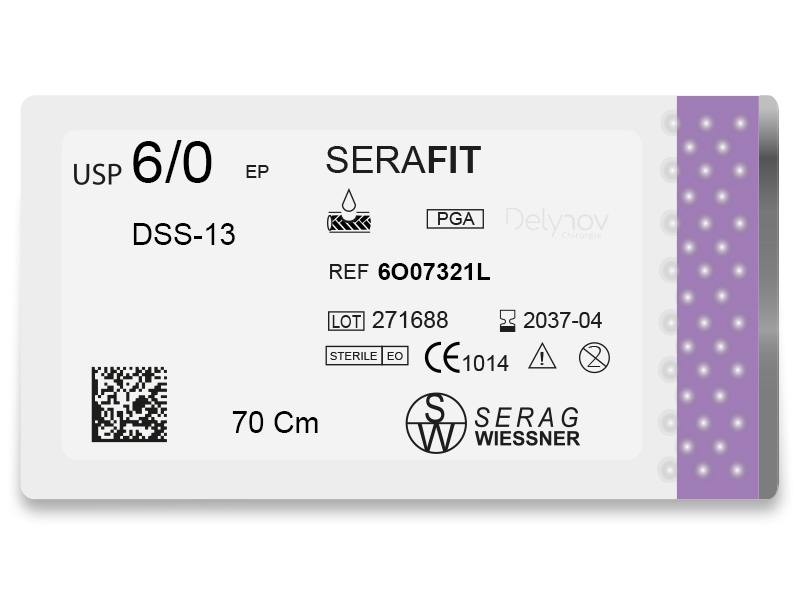
SERAFIT absorbable violet (6/0) DSS-13 needle 70 CM box of 24 sutures - Serag & Wiessner (6O07321L) - Delynov
Product features
The SERAFIT suture by Serag-Wiessner GmbH & Co. KG is a monofilament synthetic medical device designed for progressive absorption in oral, periodontal, and implant surgery.
- Material: de suture multifilament tressé, synthétique, résorbable. il est composé de l'homopolymère de l'acide glycolique. serafit® peut être recouvert de stéarate de calcium avec polycaprolactone ou d'acide polyglycolique/polyligatures sont un type particulier de suture dont l'objectif est de fermer des organes creux..
- Absorption: Rapid, progressive absorption by hydrolysis.
- Needle: DSS-13 (13 mm), 3/8 circle, atraumatic triangular tip.
- Format: Thread length 70 cm, caliber 6/0 (USP).
- Packaging: Box of 24 single-use sterile sutures.
- Compliance: Medical device Class III, CE marking CE1014.
- Manufacturer: Serag-Wiessner GmbH & Co. KG.
Fabricant : serag-wiessner gmbh & co. kg, zum kugelfang 8-12, 95119 naila/germany usage prévu : suture chirurgicale : serafit est un matériau de suture multifilament tressé, synthétique, résorbable. il est composé de l'homopolymère de l'acide glycolique. serafit® peut être recouvert de stéarate de calcium avec polycaprolactone ou d'acide polyglycolique/polyligatures sont un type particulier de suture dont l'objectif est de fermer des organes creux.
serafit® est dégradé par hydrolyse dans les tissus pour former de l'acide glycolique qui est ensuite métabolisé dans l'organisme. cette résorption se manifeste d'abord par une réduction de la tension puis, plus tard, par une perte de masse du fil. la force de rupture perd environ 60 % de sa valeur initiale après 14 jours (in vitro). la résorption est terminée après 90 jours environ (in-vivo). lire attentivement la notice. avertissement et précautions : contre-indications serafit® ne doit pas être utilisé lorsqu'une stabilité plus prolongée ou à long terme du matériel de suture est requise. le dispositif ne doit pas être utilisé chez les patients présentant des allergies à l'un des composants du produit. restrictions et limites d'utilisation/ remarques/interactions les exigences du matériel de suture et les techniques requises varient selon l'indication. c'est pourquoi l'utilisateur doit être familiarisé avec les techniques chirurgicales à utiliser. il convient de tenir compte des caractéristiques in-vivo du matériel de suture concerné dans le choix du matériel de suture. serafit® doit être utilisé avec prudence chez les patients présentant un retard de cicatrisation. il convient d'être prudent dans l'utilisation de sutures résorbables dans des tissus présentant une faible irrigation sanguine, étant donné que l'extrusion de la suture et une résorption retardée sont possibles. l'utilisation des sutures résorbables peut s'avérer inadéquate chez les personnes âgées, dénutries ou invalides. comme tous les corps étrangers, serafit® peut causer la formation de calculs lorsqu'il est exposé à un contact prolongé avec des solutions salines (par exemple dans les voies biliaires ou urinaires). l'utilisation complémentaire de matériaux de suture non résorbables ou de techniques d'immobilisation adaptées peut être requise dans le cas de sutures sous tension ou nécessitant un soutien plus important. l'utilisation de mesures auxiliaires adaptées est nécessaire pour les sutures dans des tissus infectés, étant donné que la structure multifilament peut prolonger l'infection. compte tenu du risque accru d'infection associé à la structure multifilament du fil, les sutures cutanées doivent si possible être intracutanées et le matériel de suture, en particulier les nœuds, doit être placé le plus profondément possible. les sutures cutanées qui restent en place plus de 7 jours peuvent causer une irritation locale et doivent être coupées ou retirées. les instruments chirurgicaux doivent être maniés avec soin pour éviter d'endommager le fil. plier des aiguilles ou les tenir en dehors de la zone recommandée peut engendrer une rupture de l'aiguille. compte tenu du risque d'infection inhérent aux piqûres d'aiguille, les aiguilles doivent être manipulées et éliminées avec un soin particulier réservé aux professionnels de santé.
What is the SERAFIT absorbable violet (6/0) suture from Serag-Wiessner?
SERAFIT absorbable violet is a high-precision synthetic surgical suture material designed by Serag-Wiessner. It is presented as a braided multifilament composed of a homopolymer of glycolic acid. This 6/0 calibre medical device offers a flexible and resistant structure, which can be coated with calcium stearate with polycaprolactone or polyglycolic acid. Its synthetic design ensures optimal handling for practitioners. Delivered in boxes of 24 sutures, each thread measures 70 cm in length, offering sufficient reach for various surgical interventions. This material is specifically developed to meet the requirements of modern surgery requiring temporary tissue support before complete healing.
What are the clinical indications and intended use for this device?
The intended use of SERAFIT is surgical suturing and tissue ligation. As an absorbable material, it is particularly indicated for soft tissue approximation and the closure of hollow organs thanks to its specific ligation properties. In oral and implant surgery, its 6/0 calibre is ideal for delicate interventions requiring great precision. The manufacturer Serag-Wiessner GmbH & Co. KG specifies that the user must be familiar with appropriate surgical techniques, as requirements vary according to the clinical indication. This device is designed to be used in situations where predictable resorption of the material is desired, thus avoiding a second intervention for the removal of stitches.
What are the technical characteristics of the DSS-13 needle?
The SERAFIT suture (reference 6O07321L) is equipped with a DSS-13 technical needle. According to specifications, the DSS code corresponds to a 3/8 circle needle featuring an atraumatic reverse cutting triangular point. This geometry is specifically designed for the penetration of delicate tissues and thin mucous membranes, minimizing tissue trauma during thread passage. The number 13 indicates a needle length of 13 mm. This configuration is particularly suited to restricted surgical environments such as the oral cavity, where the precision of the movement is crucial. The combination of a 6/0 thread and a DSS-13 needle allows for fine and secure handling for the dental surgeon or implantologist.
What are the contraindications for the use of absorbable SERAFIT?
The use of SERAFIT has certain limits defined by the manufacturer Serag-Wiessner. It must not be used when stability of the suture material is required over a prolonged or long-term period. Furthermore, this device is strictly contraindicated in patients with known allergies to any of its components, notably the homopolymer of glycolic acid, calcium stearate, or polycaprolactone. Particular caution is recommended in patients with delayed healing or in tissues with low blood supply, as this may lead to suture extrusion or delayed resorption. Use may prove inadequate in certain specific clinical contexts that the practitioner must evaluate before the intervention.
How does the resorption process take place and what are the precautions?
SERAFIT is an absorbable material that degrades by hydrolysis in the tissues, forming glycolic acid which is then metabolized by the body. This process results first in a reduction of surface tension, then in a loss of mass of the thread. In vitro, the breaking strength loses approximately 60% of its initial value after 14 days. Complete resorption is generally observed after approximately 90 days in-vivo. Practitioners must take these characteristics into account when choosing the material. It is advised to handle the thread with care and read the instructions carefully. Particular attention must be paid to the blood supply of the operative site to guarantee resorption kinetics consistent with clinical expectations.
Who is the manufacturer and what safety standards are met?
This medical device is manufactured by Serag-Wiessner GmbH & Co. KG, a company based in Naila, Germany. The product benefits from strict regulatory compliance, being classified as Class III, which corresponds to the highest requirement level for implantable medical devices. It bears the CE1014 marking, guaranteeing compliance with current European standards, notably the Medical Device Regulation (MDR). The traceability and manufacturing quality of Serag-Wiessner ensure health professionals a reliable and secure material for their surgical acts. Each box of 24 units is packaged to maintain the integrity and sterility of the material until its use in the operating theater.
State of the art
Modern synthetic sutures - absorbable or non-absorbable - are central to wound healing in oral surgery. Recent advances focus on reducing post-operative infections.
Specifications
| Manufacturer | Serag-Wiessner Suture Materials |
| Tags | |
|---|---|
| Tags | |