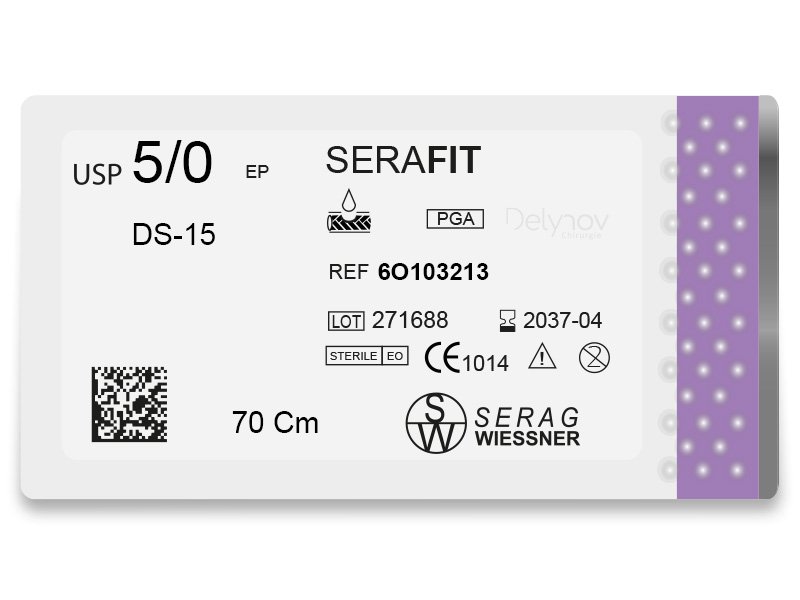
SERAFIT absorbable purple (5/0) needle DS-15 70 CM box of 24 sutures - Serag & Wiessner (6O103213) - Delynov
The SERAFIT suture by Serag-Wiessner GmbH & Co. KG is a monofilament synthetic medical device designed for progressive absorption in oral, periodontal, and implant surgery.
- Absorption: Rapid, progressive absorption by hydrolysis.
- Needle: DS-15 (15 mm), 3/8 circle, triangular reverse cutting tip.
- Format: Thread length 70 cm, caliber 5/0 (USP).
- Packaging: Box of 24 single-use sterile sutures.
- Compliance: Medical device Class III, CE marking CE1014.
- Manufacturer: Serag-Wiessner GmbH & Co. KG.
What is the violet absorbable SERAFIT (5/0)?
SERAFIT from the brand Serag-Wiessner is a synthetic and absorbable suture medical device. It comes in the form of a braided multifilament composed of a glycolic acid homopolymer. This material is specifically designed to offer optimal flexibility during surgical handling. To improve its sliding properties, it can be coated with calcium stearate with polycaprolactone or polyglycolic acid. This 5/0 calibre thread, with a length of 70cm, is colored violet to ensure excellent visibility in the operative field, thus facilitating the practitioner's work when performing sutures.
What are the clinical indications for this suture?
This oral surgery suture thread is indicated for soft tissue approximation where absorption of the material is desired. In daily practice, it is used by dental surgeons and implantologists for flap closure, gingival grafts, or complex extractions. Although the manufacturer's text mentions its use as a ligature for hollow organs, its 5/0 calibre makes it particularly relevant for micro-surgery and periodontology. The choice of this material must always be validated by the user based on the surgical technique employed and the in-vivo characteristics necessary for patient healing.
What are the technical characteristics of the DS-15 needle?
The DS-15 needle equipped on this Serag-Wiessner reference has specific properties for fine surgery. The 'DS' code designates a 3/8 circle needle with a triangular reverse cutting point. This geometry is ideal for passing through dense or keratinized tissues without causing involuntary tissue tearing, as the cutting edge is located on the outside of the curvature. The number '15' indicates a needle body length of 15 mm. This configuration is a standard for periodontology suture thread, allowing precise passage through interdental spaces and thin mucous membranes.
What are the contraindications for the use of SERAFIT?
The use of SERAFIT is formally contraindicated in clinical situations requiring long-term or permanent mechanical stability of the suture material. Furthermore, this device must never be used in patients with known hypersensitivity or allergies to any of its components, notably glycolic acid, calcium stearate, or polycaprolactone. The manufacturer also recommends increased caution in patients with delayed healing or in tissues with low blood supply, as these conditions can lead to suture extrusion or delayed absorption.
How does absorption occur and what are the precautions?
The absorption of this 5/0 absorbable suture occurs through a process of hydrolysis within the tissues, transforming the polymer into glycolic acid which is then metabolized. This process first results in a decrease in breaking strength, which loses approximately 60% of its initial value after 14 days in vitro. Total mass loss of the thread occurs later, with absorption generally completed after approximately 90 days in-vivo. It is essential that the practitioner masters the knotting techniques specific to synthetic multifilaments and takes these timeframes into account to adapt post-operative follow-up, particularly in cases of systemic factors affecting healing.
Who is the manufacturer and what standards are respected?
This device is manufactured by Serag-Wiessner GmbH & Co. KG, a recognized manufacturer located in Germany. The product benefits from a high level of regulatory safety, being classified as Class III according to European standards relating to medical devices. It bears the CE1014 marking, guaranteeing its compliance with essential health and safety requirements. Each box contains 24 sterile sutures under reference 6O103213. As a critical class medical device, it must be handled exclusively by healthcare professionals trained in surgical techniques, strictly following the instructions in the manual provided by Serag-Wiessner.
State of the art
Modern synthetic sutures - absorbable or non-absorbable - are central to wound healing in oral surgery. Recent advances focus on reducing post-operative infections.
Specifications
| Manufacturer | Serag-Wiessner Suture Materials |
| Tags | |
|---|---|
| Tags | |