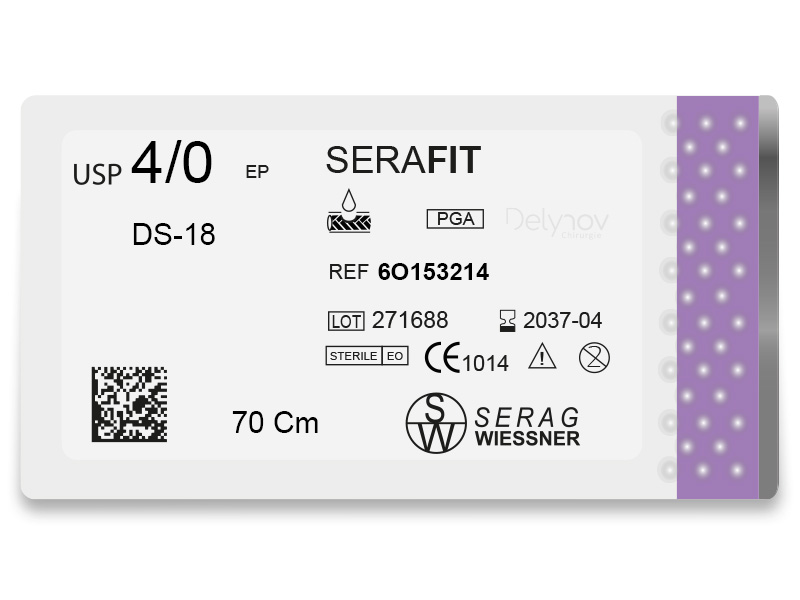
SERAFIT absorbable purple (4/0) needle DS-18 70 CM box of 24 sutures - Serag & Wiessner (6O153214) - Delynov
The SERAFIT suture by Serag-Wiessner GmbH & Co. KG is a monofilament synthetic medical device designed for progressive absorption in oral, periodontal, and implant surgery.
- Absorption: Rapid, progressive absorption by hydrolysis.
- Needle: DS-18 (18 mm), 3/8 circle, triangular reverse cutting tip.
- Format: Thread length 70 cm, caliber 4/0 (USP).
- Packaging: Box of 24 single-use sterile sutures.
- Compliance: Medical device Class III, CE marking CE1014.
- Manufacturer: Serag-Wiessner GmbH & Co. KG.
What is the SERAFIT absorbable violet (4/0) suture?
SERAFIT from the brand Serag-Wiessner is a Class III medical device intended for surgical suturing. It comes in the form of a synthetic braided multifilament material, designed from a glycolic acid homopolymer. Its braided structure ensures excellent maneuverability and knot security essential during delicate interventions. This suture thread features a violet coloring for increased visibility in the operative field. Packaged in boxes of 24 sutures, each unit includes a thread of 70cm in length with a 4/0 calibre, meeting the precision requirements of dental surgeons and implantologists.
What are the clinical indications for this dental suture thread?
In oral and implant surgery, this dental suture thread is indicated for the approximation of mucosal edges and the closure of operative sites. As an absorbable material, it is particularly suitable for procedures where suture removal is not desired or when tissues require temporary support. The manufacturer Serag-Wiessner specifies that SERAFIT can also be used for ligatures aimed at closing hollow organs. Its use is recommended for practitioners mastering specific surgical techniques, as material requirements vary according to the clinical indication and the nature of the tissues to be sutured.
What are the technical characteristics of the DS-18 needle?
The DS-18 needle equipping this reference 6O153214 is a 3/8 circle type needle. The terminology 'DS' designates a reverse cutting triangular tip. This geometry is specifically designed to pass through dense and fibrous tissues, frequent in oral surgery, by minimizing trauma and preventing the cutting edge from cutting toward the inside of the wound, which prevents accidental tears. The number 18 indicates a needle body length of 18 mm, offering an ideal compromise between maneuverability in restricted spaces and control during transgingival passage.
What are the contraindications for the use of SERAFIT suture?
The use of SERAFIT suture from Serag-Wiessner is strictly contraindicated in clinical situations requiring long-term or prolonged mechanical stability of the suture material. Furthermore, this device must never be implanted in patients with a known allergy to any of its components, including glycolic acid, calcium stearate, polycaprolactone, or polyglycolic acid. Increased caution should also be observed in patients suffering from healing delays or in tissues with low blood supply, as these conditions can lead to suture extrusion or delayed resorption.
How does resorption occur and what precautions should be taken?
Resorption of SERAFIT occurs by hydrolysis within the tissues, transforming the polymer into glycolic acid which is then metabolized by the body. This process results first in a loss of tensile strength, which decreases by approximately 60% after 14 days in vitro. Mass resorption of the thread is generally complete after approximately 90 days in-vivo. The practitioner must take these characteristics into account when choosing the material. It is recommended to be vigilant when using in poorly irrigated areas. The choice of suture technique and the 4/0 calibre must be adapted to the specific clinical situation to guarantee optimal healing.
Who is the manufacturer and what standards are met by this product?
The SERAFIT suture is manufactured by Serag-Wiessner GmbH & Co. KG, a recognized manufacturer based in Germany. This medical device is certified compliant with European requirements with the CE1014 marking. Categorized as Class III according to current regulations, it meets the strictest safety and performance standards for absorbable surgical implants. Each box of 24 sutures is delivered with a detailed technical notice that the user must read carefully before any intervention. The traceability and manufacturing quality of Serag-Wiessner guarantee surgeons reliable material for their daily oral surgery procedures.
State of the art
Modern synthetic sutures - absorbable or non-absorbable - are central to wound healing in oral surgery. Recent advances focus on reducing post-operative infections.
Specifications
| Manufacturer | Serag-Wiessner Suture Materials |
| Our selection | Best seller |
| Tags | |
|---|---|
| Tags | |