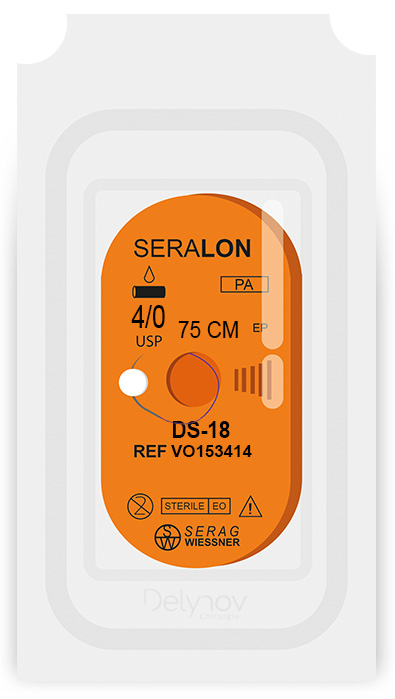
SERALON non-absorbable blue (4/0) DS-18 needle of 75 CM box of 24 sutures - Serag & Wiessner (VO153414) - Delynov
The SERALON suture by Serag-Wiessner GmbH & Co. KG is a non-absorbable monofilament synthetic medical device, indicated for oral surgery and implantology where prolonged material stability is required.
- Material: Polyamide (Nylon).
- Type: Non-absorbable (suture removal required after healing).
- Needle: DS-18 (18 mm), 3/8 circle, triangular reverse cutting tip.
- Format: Thread length 75 cm, caliber 4/0 (USP).
- Packaging: Box of 24 single-use sterile sutures.
- Compliance: Medical device Class IIb, CE marking CE1014.
- Manufacturer: Serag-Wiessner GmbH & Co. KG.
What is the SERALON non-absorbable blue 4/0 suture?
SERALON by Serag-Wiessner is a synthetic, non-absorbable surgical suture material made from polyamide (nylon). It comes in the form of a monofilament thread, giving it a smooth and homogeneous surface. This structure is particularly advantageous for avoiding capillarity and the accumulation of bacterial plaque along the thread. The 4/0 calibre is a standard in oral surgery, offering a balance between tensile strength and fineness. This thread is colored blue with phthalocyanine blue (color index no. 74160) to ensure excellent visibility in the surgical field, facilitating its identification during placement and stitch removal.
What are the clinical indications in oral surgery?
In oral and implant surgery, SERALON 4/0 is indicated for closing mucosal incisions and maintaining flaps. Its non-absorbable nature makes it a preferred choice for interventions requiring stable mechanical support during the initial healing phase, such as after tooth extraction, implant placement, or gingival grafting. Although the MDR text does not specify exclusive indications, the use of polyamide is common for cutaneous and mucosal sutures where minimal tissue reaction is sought. This thread complies with the European Pharmacopoeia monograph concerning sterile non-absorbable sutures, guaranteeing its adequacy with current clinical requirements.
What are the technical characteristics of the DS-18 needle?
The DS-18 needle equipped with this Serag-Wiessner suture has specific properties for dental surgery. The code 'DS' designates a 3/8 circle needle with a reverse cutting triangular tip. This geometry is ideal for passing through dense or keratinized tissues, such as the attached gingiva or the palate, without risk of tissue tearing towards the wound edge. The number 18 indicates a length of 18mm, offering maneuverability adapted to the restricted spaces of the oral cavity. The thread length of 75cm allows for several simple stitches or continuous sutures with a single needle, thus optimizing operative time and stock management at the practice.
What are the contraindications for using this suture?
The use of SERALON is subject to several strict contraindications defined by the manufacturer Serag-Wiessner GmbH & Co. KG. It is formally contraindicated for any direct contact with the heart, central nervous system, or central circulatory system. Furthermore, it must not be used in patients with a known allergy to polyamide or the mentioned dyes. A major point of vigilance concerns the progressive loss of tensile strength of nylon in the body over time; therefore, it is not suitable for clinical situations requiring prolonged and permanent mechanical stability of the suture material. Finally, its use is discouraged in prolonged contact with saline solutions (biliary or urinary tracts) to avoid stone formation.
What are the precautions related to the non-absorbable nature of the thread?
As SERALON is a non-absorbable suture, it must be manually removed once clinical healing is achieved, generally after 7 to 14 days in the oral area. Due to the high natural elasticity of polyamide monofilament threads, the manufacturer recommends performing one or two additional knots compared to braided threads to guarantee the security and strength of the suture. This precaution avoids accidental loosening of knots due to the shape memory of nylon. Like any foreign body, clinical monitoring is necessary to prevent any inflammatory reaction. It is also noted that for use in ophthalmic surgery, specific warnings apply regarding risks related to prolonged exposure.
Who is the manufacturer and what standards are respected?
This suture is manufactured by Serag-Wiessner GmbH & Co. KG, a recognized company based in Naila, Germany. The product carries the CE1014 marking, certifying its compliance with European safety and performance requirements. It is classified as a Class IIb medical device according to current regulations. SERALON strictly meets the criteria of the current edition of the European Pharmacopoeia (EP) monograph relative to sterile non-absorbable sutures. Technical reference VO153414 guarantees the traceability of the device. Practitioners must carefully read the enclosed instructions to respect all warnings and precautions for use provided by the manufacturer when using this nylon surgical suture material.
State of the art
Modern synthetic sutures - absorbable or non-absorbable - are central to wound healing in oral surgery. Recent advances focus on reducing post-operative infections.
Specifications
| Manufacturer | Serag-Wiessner Suture Materials |
| Tags | |
|---|---|
| Tags | |